


Window tinting vs. wrapping: EU rules (70% VLT), costs & tech
- Posted on
- By Autoglas Concurrent
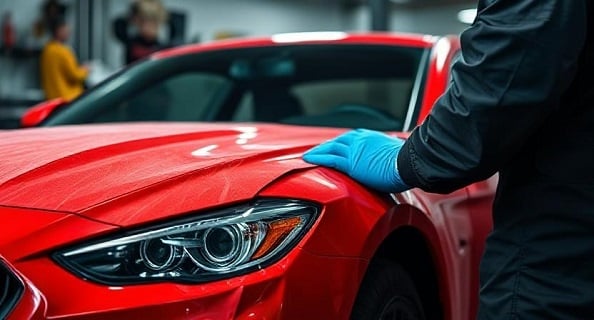
There are plenty of ways to change the look of your car. A car wash often does wonders, but if you want to go a step further, take a look at the possibilities offered by car wrapping. Tinting or shading of car windows is another way to give your car a completely different look. On this page, you will find everything you need to know about the rules and options, so you can easily decide if this is the choice for your car.
Go directly to:
- What exactly is car wrapping or car window tinting?
- Can you shade or tint your car windows just like that?
- Government rules on car window tinting
- EU regulations vs. Dutch law: 55% to 75% light transmission
- Rules around rear side window tinting
- Rear window shading and tinting: watch the mirrors
- Why choose to wrap your car or tint your car windows?
- Car window tinting costs
- Have your car windows treated by a professionall
What exactly is car wrapping or car window tinting?
Car wrapping is nothing more than the application of a specially designed foil. The foil can be applied to the paint, or to the car window. When it comes to ‘car wrapping’, it usually involves applying foil to the paintwork, whereas ‘tinting’ or ‘shading’ invariably involves the car windows.
Can you shade or tint your car windows just like that?
There are strict rules around car window tinting, but the strictest rules relate only to car windows through which you must have a clear view (and fellow road users must be able to see into the car). This means that much less is possible on the windscreen and front side windows than the rear side windows. As the windscreen should not have any discolouration and should offer a clear view of the road, regular proper cleaning of the windscreen is therefore wise. Specific rules apply to rear windows. Below, you will find all the rules conveniently listed so you can immediately see what the options are, including the answer to the frequently asked question of how much may you tint windows.
Government rules on car window tinting
It is important to note that while Autoglas Concurrent operates internationally, tinting laws can vary slightly between EU member states. Always ensure your vehicle complies with the local regulations of the country where it is registered.
The rules below are taken from the central government website, adapted to the subject of having your car windows tinted or shaded. Violation of the rules can lead to fines or even having to surrender your registration certificate. Specialists are aware of the regulations and can always assist you with this.
Do you want to make sure you make the best choice with tailor-made advice on tinting and the possibilities for your car? Then ask Autoglas Concurrent, the specialist in car window tinting with attractive prices, who will be happy to assist you personally.
EU regulations vs. Dutch law: 55% to 75% light transmission
When tinting the front of your vehicle, you must adhere to strict safety standards. According to UN/ECE Regulation 43, the European standard for automotive glass, windscreens must generally maintain a light transmission (VLT) of at least 75%, while front side windows must allow at least 70% of light to pass through.
However, the Netherlands has a specific national exception. In the Netherlands, the legal limit for both the windscreen and the front side windows is set at a minimum of 55% VLT. This means that if you want to have the windscreen of your BMW 3 Series tinted, for example, it is legally permitted as long as the 55% threshold is respected.
Why this matters for international drivers
If your car is registered in the Netherlands, you can legally drive with 55% transmission. However, if you frequently drive in other EU countries like Belgium or Germany, be aware that their local authorities strictly enforce the 70% limit. At Autoglas Concurrent, we advise our international clients to aim for the 70% European standard to ensure hassle-free travel across borders, while still offering the maximum legal 55% for our domestic Dutch clients.
Chameleon film and compliance
There are various types of foil used for window tinting. Chameleon film for windscreens is particularly popular due to its dynamic colour-changing effect. When installed by a professional, these films are fully compliant with the 55% VLT rule in the Netherlands, combining a high-end aesthetic with legal certainty.
Rules around rear side window tinting
There are no specific rules around tinting or shading the side windows next to the rear seat(s), as they play a minor role when it comes to road safety. So going through the rules for tinted windows is not directly necessary here. Thus, even 5% foil can be applied here, a special foil that allows only 5% of light to pass through. Specifically, this means no one can see into the car from outside. Such values are mainly seen in vans, high-ranking cars, security cars and cars used by government organisations, for example when it must be unclear in which car the person is sitting (in case of attacks or assaults).
Rear window shading and tinting: watch the mirrors
Rear windows are a special story when it comes to tinting and even participating in traffic. If there is no right exterior mirror on your car, the view through the rear window should not be obstructed. So that means you cannot just have it tinted with barely translucent foil. You cannot put objects on the rear window shelf either, as you are also breaking traffic rules by doing so.
However, almost all cars do have a right-side exterior mirror, so you do not need to be able to look through the rear window. The right exterior mirror replaces the rear-view mirror, so to speak. This means that, in most cases, you can also simply have the rear window tinted or shaded.
Why choose to wrap your car or tint your car windows?
You can choose to have your car wrapped because there are a number of advantages to car wrapping. However, keep in mind that this only applies when you choose a car wrap specialist. We have listed the main benefits of car wrapping for you:
- The carwrap is a protective layer for the paintwork, thus providing extra protection for your car.
- A carwrap is a way to give the car a completely different look within a very short time.
- Car wraps are temporary and can therefore be replaced whenever you want.
- Since there are numerous different wraps and colours, you can always find an option that perfectly suits your needs and preferences.
- It is possible to personalise the company car with a carwrap, for example with advertising on the car or even multiple colour shades to reflect your company logo in the carwrap.
The advantages of car window tinting are also numerous. Not only do you change the look of the car (it becomes ‘tougher’ and sportier), you also provide an increased degree of privacy. This is especially true for the boot and rear seats, as this is often where foil is used that allows considerably less light through.
Car window tinting costs
If the cost of car window tinting is important to you, it is good to know that the cost of window tinting varies greatly. It all depends on which car windows you have tinted, how many windows need to be tinted and which foil (such as Chameleon foil for windscreens) should be used. You can always ask the professional for the price of window tinting so that you know exactly what the total cost will be.
Have your car windows treated by a professional
Are you interested in car wrapping or tinting your car windows? Then enquire today about options at Autoglas Concurrent, a popular car wrapping and tinted car window company in the Netherlands and Belgium. Here you will find not only Chameleon foil for windscreens that is legal, but also plenty of other options for tinted windows for your car.