Go directly to:
The Honda Prelude is a well-known model from Japan that received a lot of attention, partly because of the moonroof, which would become the model's calling card at dealerships. It became a reasonable success during its original production years and would even return in 2025. Some 8,000 units have been sold in the Netherlands at the time of writing. If you have a Prelude whose windscreen needs replacing, then you have come to the right place for a new windscreen with the best value for money. Before we explain to you how this is possible, let's take a look at this special Honda.
The first generation of the Honda Prelude was launched in Japan in November 1978. Two months later came the international launch of the model at the AutoRAI in Amsterdam. The Prelude was loosely based on the Honda Accord, but would come to be known mainly as the first Honda with a moonroof.
The name “Prelude” actually belonged to Toyota, but was given to Honda, which used it to create a series of models with names based on music, along with models like the Honda Quintet, Honda Concerto, Honda Jazz and the Honda Ballade.
The Prelude was a compact sporty car and became the first Honda to have an engine under 2.0 litres with power steering. However, considerable concessions were made to make this a sports car. According to the marketing, the Prelude was a 2+2 model, but at most it could only accommodate small children in the back seat, as there was no room for an adult.
The first generation got a minor facelift in 1981, replacing the dashboard with a more traditional one and giving the model a steel trim around the car.
The first generation was a success. More than 310,000 units were made, of which more than 80% were sold outside Japan, and Honda will have been especially pleased with the latter.
A year after the facelift, Honda launched the second generation (spring 1983 for the international market). The Prelude got a completely new platform and got more powerful engines, although that was not what immediately caught the eye. Indeed, the second generation got headlights that rose, which provided even more aerodynamics as the front built up less drag. The downside, however, was that when the headlights were raised, this had an immediate negative effect.
The 2.0-litre version was supposed to make the sports car popular in Japan, but this was short-lived. This was because the road tax in Japan was considerably higher for the 2.0 than for the 1.8 litre, and this meant that the 2.0 litre had much less success in Japan itself. In Europe, success was much greater, as in Britain, the second generation was much more popular than the first generation and the model saw eager sales, despite the fact that sports cars were losing out in the market, where Ford even took the Ford Capri away from dealers due to disappointing sales figures.
In 1987, the third generation entered the market, both in Japan and the rest of the world. This model came with reinforced steel, improved aerodynamics and, the most striking feature, the ability to steer all wheels, instead of just the front axle (which is common). By using two steering units (connected of course), it was considerably easier to change direction with a small steering correction and this also provided many advantages when parking, as it made the car more manoeuvrable.
Honda thought that around 1 in 3 people would choose this, and within a year it saw that this was completely wrong. In Japan alone, 80% chose this option, almost 2.5 times more than Honda thought. The third generation also became popular in Europe, where the model came third in the 1988 European Car of the Year title (behind the Citroën AX and the Peugeot 405). At that time, no Japanese car had managed to finish so high on the list (although the Nissan Micra would put an end to this five years later by winning the award).
In 1989, the Prelude received a thorough facelift, with changes to the front and rear bumper, as well as many parts of the interior. Incidentally, the facelift did not hit the US market until 1990.
In 1991, the fourth generation of the Prelude was released (1992 international), with the steering mechanism becoming all-electric with a 2.2-litre engine, and drawing inspiration from the Honda Ascot Innova for the design.
Unfortunately, the fourth generation no longer had headlights that could flip up. Also, the rear was much rounder and taller than that of the previous generations, and Honda decided to replace the moonroof with a sunroof, leaving another characteristic feature of the model to the Prelude.
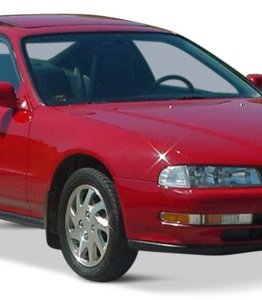
By the fifth generation in 1996, the Prelude appeared to go back in time in part, as its shape was much more similar to that of the third generation than that of the fourth. Also, from this point on, most models came with 16-inch aluminium rims and standard ABS. In 1999, the fifth generation would also get a refresh, which meant that the engine would get an extra 5hp, including a new grille and a modification so that the interior filter was simply accessible for replacement.
Honda has had a number of model names return recently, such as those of the Honda Passport and Honda Integra. The Honda Prelude also returned in 2025, but this time not as a sporty car with a roaring engine, but as a hybrid, part of Honda's larger project to make only plug-in cars. The Honda Prelude will replace the Honda Civic and Honda Accord Coupé in 2025.
The Honda Prelude is incredibly well known in the Netherlands, although chances are you don't even know exactly (anymore) why. In the 1990s, Bassie and Adriaan's Simca-Matra Rancho was replaced by a Honda Prelude (with matching caravan, which played a major role in many episodes), a car that was modified (e.g. eyes for the headlights, which could even be used to wink) and that would assist the circus duo as well as robot boyfriend Robin on their countless adventures all over the world. There are still replicas on the market that sell for a lot of money, although the range of Bassie-and-Adrian Preludes on offer has greatly diminished over the years.
Honda will not be disappointed with the sales figures, especially when most models went abroad and Honda was not mainly successful in Japan itself. It is notable, however, that the success of the Prelude declined considerably after the third generation, partly due to the declining demand for sports cars and also competition from Honda itself, which came out with similar models (such as the Honda S2000).
Below, we are happy to share a Honda advertisement that can be counted among the best car advertisements from Japan:
Good road visibility is important as it is necessary to minimise the risk of accidents. Therefore, there are strict rules about when the windscreen should be replaced. If the windscreen damage is in the driver's field of vision and is a branched crack or a chip at least two centimetres in diameter, you will need a new windscreen for your Honda Prelude. In all other cases, you can choose to continue driving with the damaged windscreen.
However, be sure to take a look below at the price of a new Honda Prelude windscreen with us first, because getting your Prelude back in optimum condition will cost you significantly less than the Honda dealer will tell you.
If you opt for our replacement windscreens, you'll already have a new Prelude windscreen for just €349. That includes VAT, and does not include any costs for fitting and/or delivery. The quality is identical to that of the original windscreens, while you pay much less. This is due to the brand logo in the original Honda windscreens, which provides an exclusive character and is included in the price.
Our unbranded windscreens, as the name suggests, have no brand logo and are therefore the best choice when you want to go for the best value for money. At the same time, you also choose the best service.
In fact, you can always come to us for on-site windscreen replacement by professional fitting partners. After all, replacing the windscreen of your Honda Prelude yourself is often not an option, because to do so you not only need the right tools, but also the right knowledge. Indeed, if you make a small mistake while replacing the windscreen, you can easily damage the new window or the car. An attempt to save money then ends up costing much more.
Are you an experienced professional yourself or do you know someone who can replace the windscreen of your Honda Prelude? Then you can also come to us for new car windows excluding fitting. You can even choose to collect your order from us, something that can definitely be a good option if you want to order several windscreens at once and further save on costs.
Do you have a Honda Prelude whose windscreen needs replacing and want to save on costs but not on quality or ease of ordering? Then you have come to the right place. Can't find the right windscreen or do you have any questions about one of our products or our way of working? If so, please contact us so that one of our specialists can help you personally within a short time.